Showing posts with label Special Matrices. Show all posts

Wednesday, 27 May 2020

Introduction to Special Matrices

My journey with Special Matrices started with Transpose Operation, you can read about it in this post as you could find few interesting ones already over there.

There are so many number of special matrices(named matrices), but we shall see few of them.

In the previous blog, we saw that Unitary Matrix U has property UU = UU  = I. I being Identity. 
In the previous blog, we saw that Orthogonal Matrix has property ATA = AAT = I, I being Identity. 


I found that few matrices are named as Normal Matrices. When A*A = AA* but need not be equal to I (identity matrix). Among complex matrices, all Unitary, Hermitian, and skew-Hermitian matrices are normal. Likewise, among real matrices, all orthogonal (ATA = AAT = I), symmetric (ATA = AAT), and skew-symmetric (ATA = AATmatrices are normal. However, it is not the case that all normal matrices are either unitary or (skew-)Hermitian.

I found Symplectic matrix interesting as i found it to be related to Transpose and Skew-Symmetric Matrix. It is a Dual Combo.

Symplectic matrix is a 2n × 2n matrix M with real entries that satisfies the condition
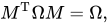
{\displaystyle M^{\text{T}}\Omega M=\Omega ,}
where MT denotes the transpose of M and Ω is a fixed 2n × 2n nonsingularskew-symmetric matrix

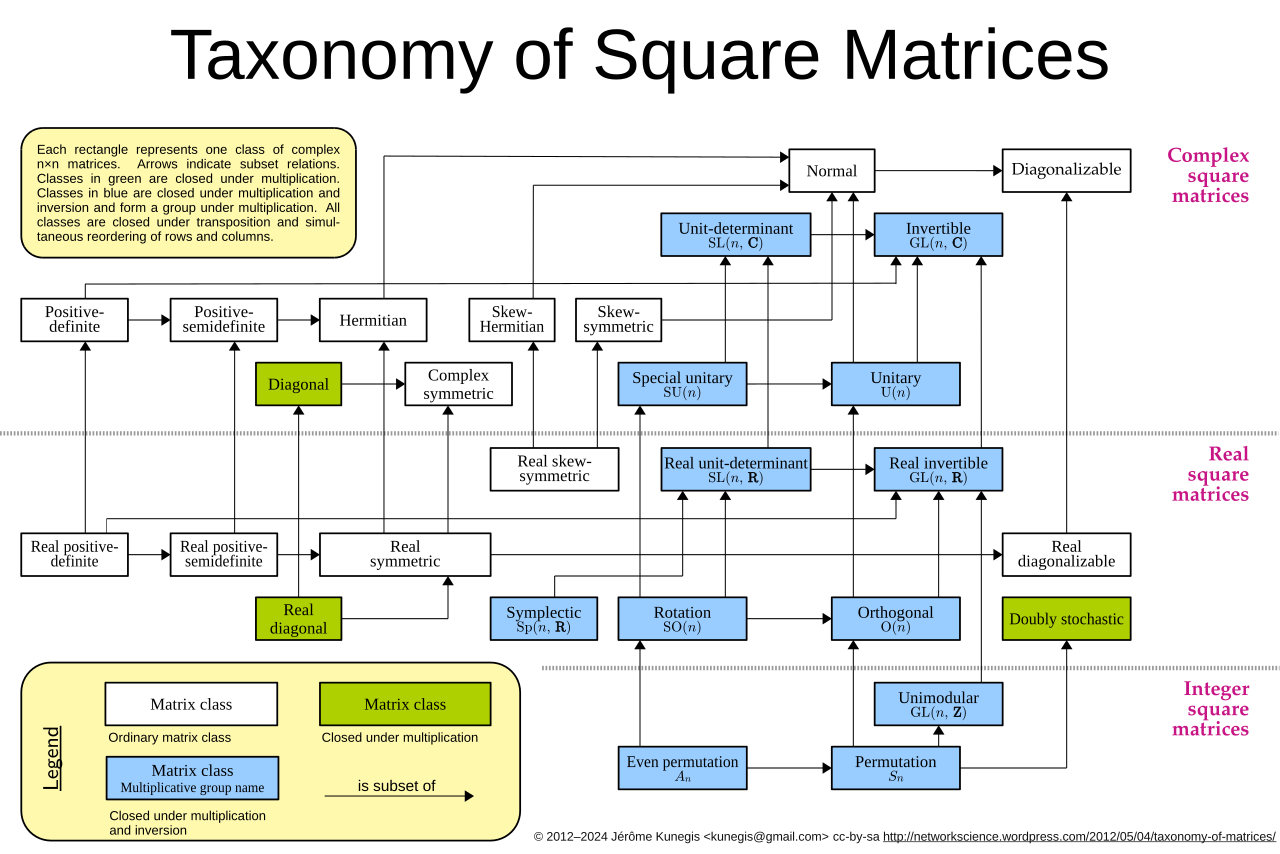
The below picture from wikipaedia, provides few named matrices and their relations. The wikipaedia page provides almost all present named matrices despite no relationship been identified. I have not gone through other interesting ones, may be they are for another blog.
Transpose Properties and Special Matrices

Transpose it very simple operation to change rows into columns and columns into rows. I had never given any importance to this operation until i found the relationship between Transpose Operation with Special Matrices. For Example we prefer Transpose of Matrix A over Inverse of Matrix A when we find the matrix is Orthogonal.

Orthogonal Matrix is a special matrix, I thought it is the only case. The real surprise came in, when dealing with Real Skew Symmetric Matrix.

In this blog I like to capture the properties of Transpose Operation of Matrix and the relation of Transpose operation with Special Matrices.

Properties of Transpose Operation: 
Let us see the properties

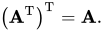
1. Inverse of Transpose: Transpose of Transpose
{\displaystyle \left(\mathbf {A} ^{\operatorname {T} }\right)^{\operatorname {T} }=\mathbf {A} .}

 2. Transpose with Additivity
{\displaystyle \left(\mathbf {A} +\mathbf {B} \right)^{\operatorname {T} }=\mathbf {A} ^{\operatorname {T} }+\mathbf {B} ^{\operatorname {T} }.}

3. Transpose with Mulitiplicativity
{\displaystyle \left(\mathbf {AB} \right)^{\operatorname {T} }=\mathbf {B} ^{\operatorname {T} }\mathbf {A} ^{\operatorname {T} }.}

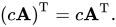
4. Transpose with Scalar Multiplication
{\displaystyle \left(c\mathbf {A} \right)^{\operatorname {T} }=c\mathbf {A} ^{\operatorname {T} }.}

5. Transpose with Determinant
{\displaystyle \det \left(\mathbf {A} ^{\operatorname {T} }\right)=\det(\mathbf {A} ).}

6. Share Same Eigen Values & Polynomial: 
Aand share same eigen values as they polynomial representation is same.

7. Dot Product with Transpose
{\displaystyle \left[\mathbf {a} \cdot \mathbf {b} \right]=\mathbf {a} ^{\operatorname {T} }\mathbf {b} ,}

8. Transpose exchange with Inverse
{\displaystyle \left(\mathbf {A} ^{\operatorname {T} }\right)^{-1}=\left(\mathbf {A} ^{-1}\right)^{\operatorname {T} }.}

9. If A has all Real entries then
ATA is a positive-semidefinite matrix. Useful for defect and condition calculation to reduce error.

10. {\displaystyle \left(\mathbf {A} \mathbf {A} ^{\operatorname {T} }\right)^{\operatorname {T} }=\left(\mathbf {A} ^{\operatorname {T} }\right)^{\operatorname {T} }\mathbf {A} ^{\operatorname {T} }=\mathbf {A} \mathbf {A} ^{\operatorname {T} }.}
 

We have seen 10 properties of Transpose Operation. Now let us see What it has to do with Special Matrices. We shall start with simple special to very special and we shall see what special property arises with it.

If A is Symmetric Matrix
{\displaystyle \mathbf {A} ^{\operatorname {T} }=\mathbf {A} .} 
Only if A = Awe call a matrix Symmetric.


If A is Orthogonal Matrix, We call a matrix A orthogonal ATA = AAT = I
{\displaystyle \mathbf {A} ^{\operatorname {T} }=\mathbf {A} ^{-1}.}


{\displaystyle \mathbf {A} ^{\operatorname {T} }=-\mathbf {A} .}
Only if  A= - we call a matrix Skew Symmetric.


If A is Hermitian Matrix, We call a matrix H hermitian if H = Conjugate Transpose of H.
{\displaystyle \mathbf {A} ^{\operatorname {T} }={\overline {\mathbf {A} }}.}
when we take transpose of hermitian we get A= conjugate of A


{\displaystyle \mathbf {A} ^{\operatorname {T} }=-{\overline {\mathbf {A} }}.}
This is a combination of both Skewed Matix and Hermitian.

If A is Unitary Matrix, We call a matrix U unitary if U−1 = U∗ or UU = UU  = I. Here * denotes conjugate transpose.
{\displaystyle \mathbf {A} ^{\operatorname {T} }={\overline {\mathbf {A} ^{-1}}}.}

For a unitary matrix U, determinant of U is 1. Hence it is called Unitary Matrix.

In the above cases we can see how various complex operation can be replaced with Transpose Operation, It is very interesting to know the application of Transpose :)

You can also read more about Special Matrices my other post.


Skill, Knowledge and Talent

I kept overwhelming with data, information, knowledge and wisdom over a period of time. And I really wanted to lean towards skilling on few ...